The Jobs Market is Resilient but the Structure Behind it Might Not Be
Australia's job numbers look impressive—but are they hiding a dangerous weakness in how growth is really happening?

Australia's unemployment rate fell to 4.4 per cent in May, and the Albanese government was quick to claim it. More than 1.25 million jobs created since the 2022 election. The lowest average unemployment of any Australian government in half a century. The headline numbers are real. The question is what they are built on.
Bottom line: Australia's labour market looks strong by the numbers that get announced at press conferences, but the composition of that strength matters as much as its scale. If the jobs growth is concentrated in sectors insulated from price signals rather than driven by genuine productivity gains, the resilience is borrowed time rather than built capacity, and the reckoning tends to arrive after the press releases stop.
Forty thousand jobs in a month is not nothing. Participation at 66.7 per cent, close to a record high, suggests people are not just finding work but actively looking for it. These are not figures to be dismissed. The government's record on headline employment is, by any honest reading, a strong one.
But headline employment is a lagging indicator. It measures what happened, not what is coming. And when you look past the number to the composition, some features of this labour market deserve more scrutiny than a joint ministerial media release tends to supply.
Government-insulated sectors are doing the heavy lifting
The first is the sectoral distribution of job creation. Australia's jobs boom has been significantly driven by health, aged care, disability services, and construction tied to government infrastructure spend. These are not bad sectors. They employ real people doing necessary work. But they are, to varying degrees, insulated from the competitive pressures that normally discipline productivity. When a sector's revenue comes primarily from government funding rather than consumer choice, the price signals that normally tell you whether resources are being used well are muffled. Jobs in those sectors can persist long after the underlying productivity case for them has weakened, then disappear when the funding cycle turns.
A wages recovery driven by mandated increases and award changes is structurally different from one driven by employers competing for workers in a tight, productive market.
Mandated wage growth and market wage growth are not the same thing
The second is wages. The government's narrative pairs job creation with wage growth, and there is something to this: real wages have begun recovering after the post-pandemic inflation hit. But a wages recovery driven by mandated increases and award changes is structurally different from one driven by employers competing for workers in a tight, productive market. One reflects improved bargaining power. The other reflects a genuine improvement in what workers produce and what that production is worth. The distinction matters enormously for whether wage growth is durable or whether it gets absorbed back into prices over time.
This is not a theoretical concern. The wage-price dynamics of 2022 to 2024 were a genuine test of how much wage growth Australia's price-setting mechanisms could absorb without feeding back into inflation. The Reserve Bank spent two years trying to answer that question with interest rates. The answer, broadly, was: not as much as the optimists hoped. Inflation proved stickier than the models suggested, the rate cycle ran longer and higher than most forecasters expected, and the distributional consequence fell hardest on mortgage-holders and renters, not on the people designing the labour market settings.
The construction pipeline will thin — and the jobs will go with it
The third concern is what happens when the construction pipeline thins. Australia has committed to an enormous infrastructure and energy transition programme. The $106 billion transition price tag for the electricity sector alone will sustain a significant chunk of construction employment for the next several years. That is not a reason to oppose the transition, but it is a reason to be careful about treating the employment it generates as evidence of a structurally healthy labour market rather than a one-time demand surge. Infrastructure and renewables construction is lumpy and finite. It does not replenish continuously the way private sector service employment does.
None of this is to say the government has mismanaged the labour market. The global comparison holds up reasonably well. Several advanced economies with different policy settings have higher unemployment, weaker participation, and worse inflation outcomes simultaneously. The argument that Australia's approach has been reckless does not survive a straightforward international comparison.
What it is to say is that the structural question, whether this resilience reflects the kind of productive capacity that survives a fiscal consolidation or a terms-of-trade shock, remains genuinely open. The government's media release does not answer it. The unemployment rate does not answer it. And an honest accounting has to hold that uncertainty rather than fold it into either the congratulatory framing of the press conference or a reflexive dismissal of what has, so far, been a decent result.
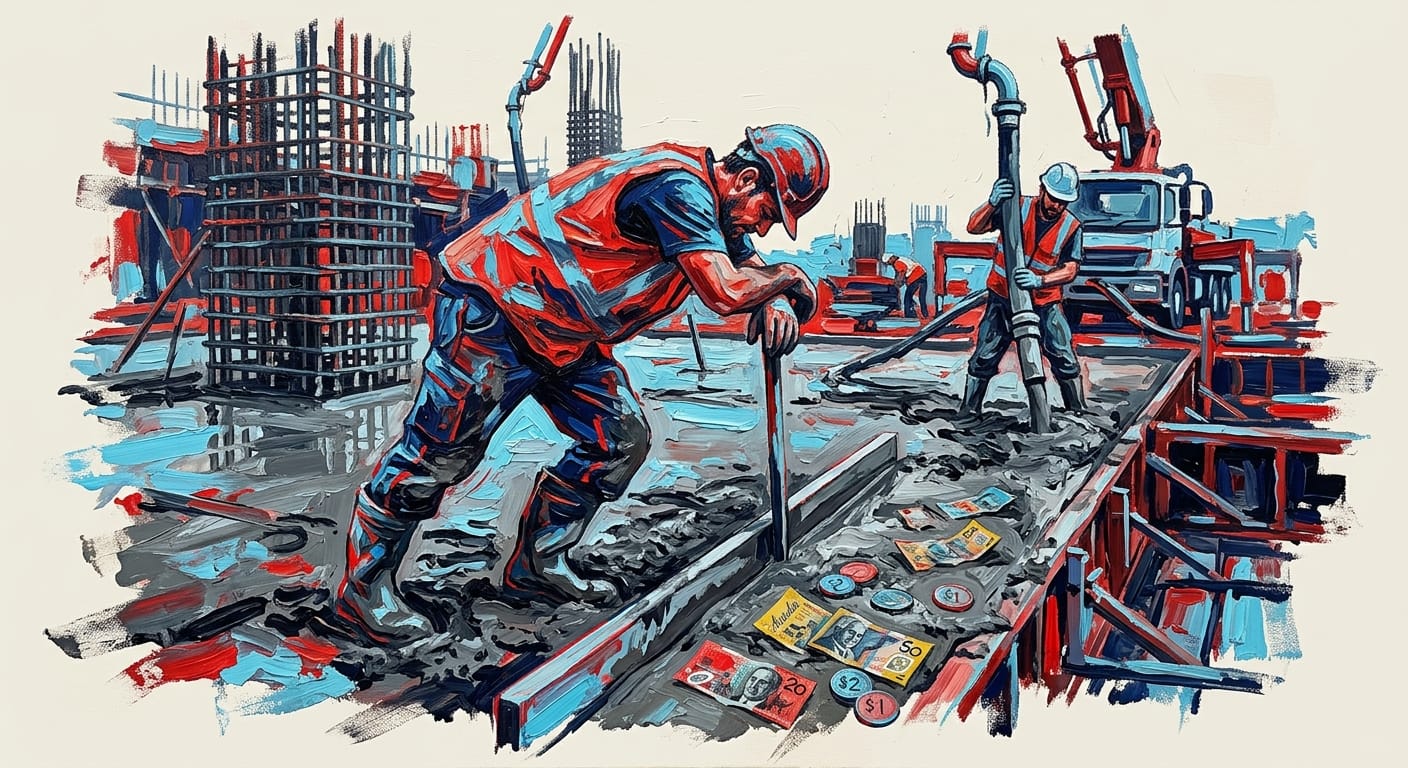
Australia has poured a good-looking slab. Whether it was mixed right is a question for when the weight goes on.
Frequently Asked Questions
Why is Australia's unemployment rate falling if the economy is under pressure?
Much of Australia's recent job creation has been concentrated in sectors funded or heavily supported by government — health, aged care, disability services, and infrastructure construction — rather than in market-driven private sector activity. These sectors are insulated from normal competitive pressures, so employment in them can remain elevated even when broader economic conditions are tightening.
What is the difference between mandated wage growth and market wage growth?
Mandated wage growth comes from award changes and government-set increases, and reflects improved bargaining power rather than underlying productivity gains. Market wage growth occurs when employers bid up wages to compete for workers in a productive, tight labour market. The distinction matters because mandated increases are more likely to feed back into inflation rather than reflect durable improvements in workers' productive output.
How long will the construction jobs boom last in Australia?
Australia's energy transition and infrastructure pipeline — with the electricity sector transition alone carrying a price tag of $106 billion — will sustain significant construction employment for several years. But infrastructure and renewables construction is finite and lumpy; it does not regenerate continuously the way private service employment does, and a demand cliff is likely when the current pipeline peaks.
Did Australia's rate rises hurt ordinary workers more than they helped?
The Reserve Bank's rate cycle of 2022 to 2024 ran longer and higher than most forecasters expected because inflation proved stickier than the models assumed. The cost of that cycle fell disproportionately on mortgage-holders and renters, while the workers who benefited most from mandated wage increases were concentrated in award-reliant, government-funded sectors — a distributional split the headline employment figures do not capture.
Is Australia's jobs market actually strong compared to other countries?
By headline measures, yes: several comparable advanced economies have higher unemployment, lower participation rates, and worse inflation outcomes simultaneously. But the international comparison speaks to scale, not structure — it does not settle the question of whether Australia's employment growth reflects genuine productive capacity or a cyclical surge in government-supported sectors that will unwind when fiscal conditions tighten.