Government keeps feeding KPMG millions despite ethics scandals
Australia's ethics rules for government suppliers exist on paper — but $51 million in active KPMG contracts raises the question of whether anyone is enforcing them.

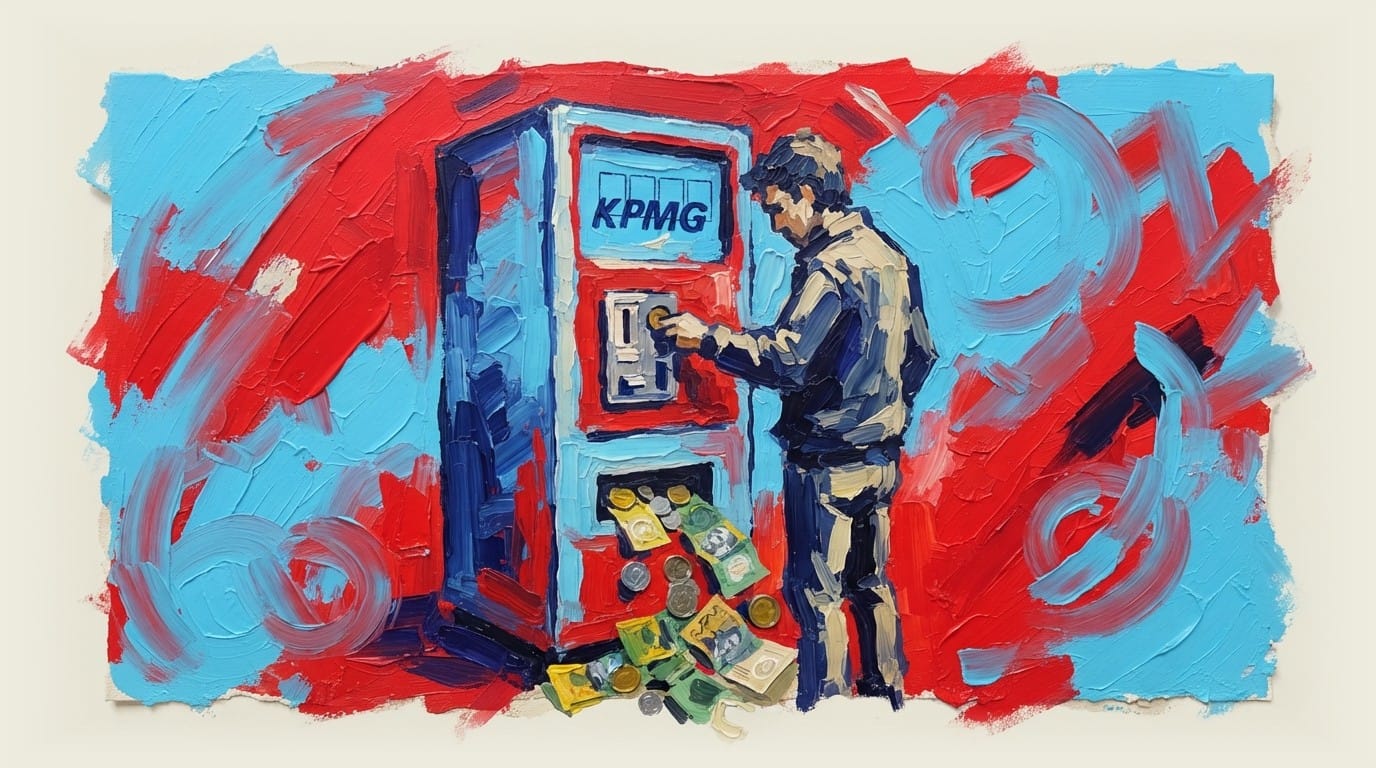
The Australian government is paying KPMG more than $51 million across eight active contracts, even as the firm navigates its own rolling ethics crisis. The logic of the arrangement is harder to explain the longer you look at it.
The Department of Finance is both KPMG's regulator and its client
The data, published under the government's own biannual reporting of contracts above $2 million, shows KPMG working across Defence, Finance, Home Affairs, and Services Australia, among others. The Department of Finance alone holds three contracts worth more than $25 million combined. That is the same department responsible for investigating KPMG's conduct. The firm under review is also the firm on the payroll. It is the kind of arrangement that would prompt raised eyebrows in a small business, let alone across the federal bureaucracy.
KPMG's admissions are not disputed. The firm has acknowledged misusing confidential client information to win audit work, and has been criticised for its handling of a whistleblower who raised concerns internally. These are not allegations hanging in the air, they are findings the firm has not contested. The government has a Commonwealth Supplier Code of Conduct. What that code requires of suppliers in circumstances like these, and whether it is actually being applied, is a question the contract data does not answer.
Structural dependency is why the contracts survive scandal
The deeper problem is structural. Australia has a public service that has grown substantially in recent years, yet the appetite for external consulting has not shrunk proportionally. The government's reliance on the Big Four reflects a hollowing out of specialist analytical capacity inside the bureaucracy over many years, a pattern that predates the current government but which successive governments have reinforced every time they reach for a consulting contract rather than build the capability in-house. The short-term logic is not irrational: procurement is faster than hiring, and skills that are needed once do not obviously justify a permanent headcount. But repeated across enough departments and enough years, it produces exactly the situation Australia is now in: a public service that cannot easily do without the firms it is supposed to be regulating.
That dependency is what makes the KPMG contracts so difficult to shift. It is not simply that officials are indifferent to the ethics record. It is that unpicking a major contractor mid-engagement carries real operational costs, and the alternative, building the capacity to not need them, takes years and requires leadership willing to absorb the short-term pain. Neither of those things recommends themselves to a government with other priorities.
The government needs KPMG because it lacks the capacity to do the work itself. Demonstrating that KPMG should be removed requires a rigorous independent evaluation, which is itself the kind of analytical work the government would normally contract out.
There is a circular quality to the whole arrangement that deserves attention. The government needs KPMG because it lacks the capacity to do the work itself. Demonstrating that KPMG should be removed requires a rigorous independent evaluation, which is itself the kind of analytical work the government would normally contract out. Contracting it to another Big Four firm raises its own conflicts. Building a regulator capable of doing this properly requires, ironically, the kind of long-term institutional investment that consulting culture has consistently crowded out.
The PwC scandal was supposed to change this
Greens Senator Barbara Pocock, who has been pushing on this issue, is right that the PwC scandal was supposed to be a turning point. The argument then was that the sector had lost its social licence and meaningful reform was coming. What has followed is a tightening of some disclosure rules and, apparently, continued nine-figure spending with the same cohort of firms. The lesson the sector appears to have absorbed is that the scandals are survivable. A temporary reputational hit, some fresh faces in the leadership suite, and the contracts return.
What would actually change the calculation is a credible cost for misconduct: not just public criticism, but removal from panels, suspension from bidding, and a genuine review of active contracts when ethical failures are admitted. Whether the government has appetite for that depends less on principle than on whether it believes it can function without these firms. Until it builds the internal capacity to test that question, the answer will keep coming back the same way.
The vending machine keeps taking the coins.
Sources
Australian Greens — RELEASE: KPMG raking it in on multimillion-dollar contracts
Frequently Asked Questions
Why is the Australian government still paying KPMG after the ethics scandal?
The contracts persist primarily because of structural dependency: the public service has hollowed out its internal analytical capacity over decades, making it operationally difficult to remove a major contractor mid-engagement. The short-term cost of unpicking active contracts outweighs the political cost of continuing them.
What did KPMG actually admit to?
KPMG has acknowledged misusing confidential client information to win audit work, and has been criticised for its treatment of a whistleblower who raised concerns internally. These are admitted findings, not pending allegations.
Why is the Department of Finance contracting KPMG a problem?
Finance holds three KPMG contracts worth more than $25 million combined — and is also the department responsible for investigating KPMG's conduct. That makes Finance simultaneously the firm's regulator and its largest client, a conflict of interest that undermines the credibility of any oversight it conducts.
What would actually stop the government from using firms with ethics violations?
A credible deterrent would require removal from supplier panels, suspension from bidding, and mandatory review of active contracts when ethical failures are admitted. Currently the Commonwealth Supplier Code of Conduct exists but whether it is being applied to KPMG has not been publicly established.
Did the PwC scandal change how Australia uses consulting firms?
Some disclosure rules were tightened following the PwC scandal, but government spending with the Big Four appears to have continued at significant scale. The KPMG contract data from the first half of 2026 suggests the sector has treated the scandals as survivable rather than structurally threatening.