Musician uses computer to make a viral cover song. Industry shocked.
A chart-topping cover made with AI vocals has the music industry in uproar — but is the outrage aimed at the right target?

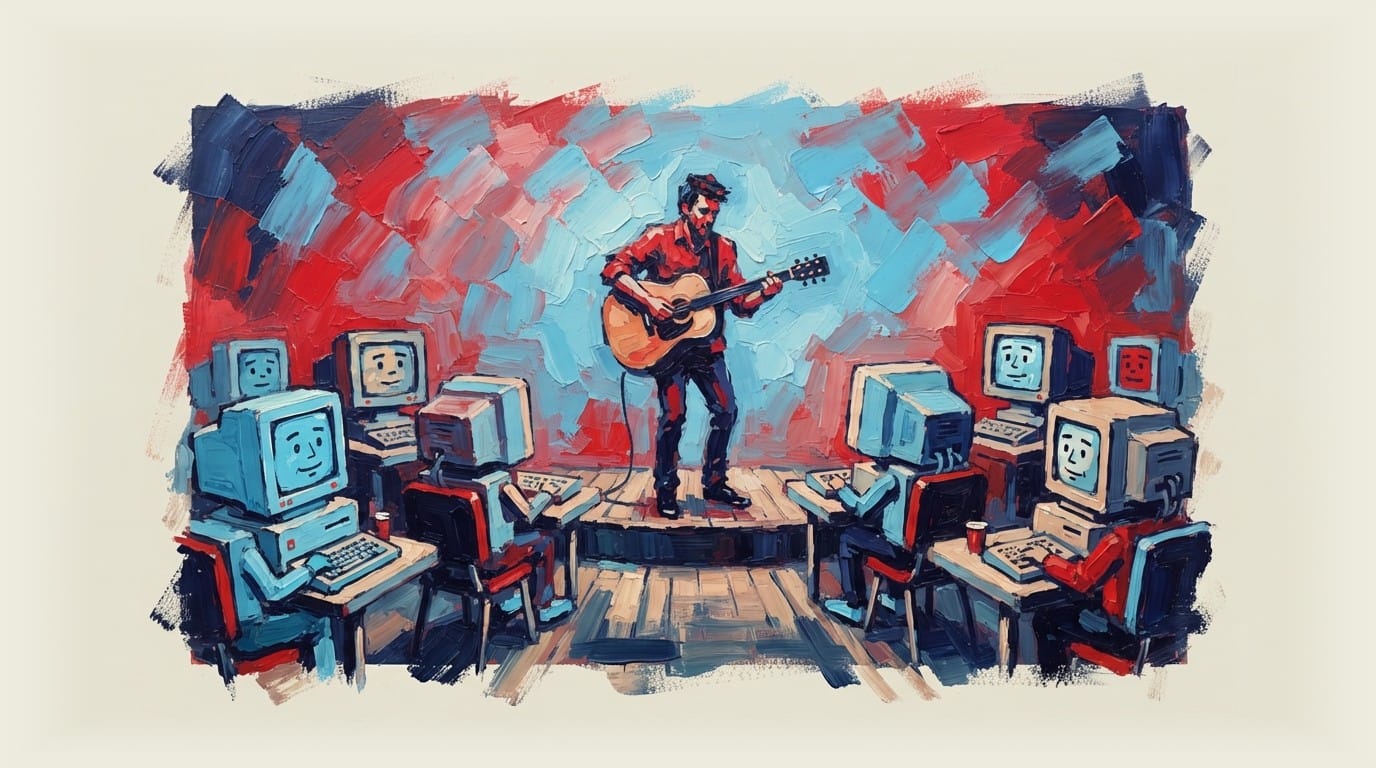
Josh Fawaz's cover of Madonna's Like a Prayer has spent four weeks at the top of Australia's national airplay charts, been streamed more than 38 million times on Spotify, cracked the top five on the Billboard Hot Dance/Electronic Songs chart, and hit number one on the UK's Official Independent Singles Breakers chart. It is, by any measure, a hit. It also uses generative AI for its vocals and drums, a fact Fawaz has now formally credited on Spotify following an ABC investigation. The music industry, predictably, is having a moment.
The specific tools change. That is almost definitional to the history of recorded music. The electric guitar alarmed purists. The synthesiser was a scandal. Auto-Tune, now so ubiquitous it functions as an aesthetic choice rather than a cheat, was once treated as evidence of civilisational decline. The recording studio itself, with its capacity to splice, layer, and construct a performance that never existed in a single room, was a fundamental rupture with the idea of music as a live human act. We made peace with all of it, eventually, because the question audiences actually answer when they press play is not "how was this made?" but "does this do something to me?"
Thirty-eight million Spotify streams suggests the answer, for a lot of people, is yes.
This is not a text-prompt track — the distinction matters
What Fawaz has done here is worth being precise about, because the conversation around AI in music tends to blur distinctions that matter. This is not a wholly AI-generated track conjured from a text prompt. It is a cover of a Madonna song, which means it draws on melody, structure, and lyrical content written by a human being almost forty years ago. Fawaz arranged it, made production decisions, and released it under his name. The AI generated the vocals and the drums. That is a collaboration between a musician and a tool, which is a description that fits a great deal of music that nobody has ever objected to.
The AI generated the vocals and the drums. That is a collaboration between a musician and a tool, which is a description that fits a great deal of music that nobody has ever objected to.
The real threat to streaming is scale, not craft
The more substantive concern in the industry is not really about this song. It is about scale. Spotify removed 75 million "spammy tracks" from its platform over the past twelve months, a figure that points to the actual problem: AI making it trivially easy to flood streaming platforms with low-effort content designed to siphon royalties rather than to be listened to. That is a genuine distortion of the ecosystem, and Spotify's decision to introduce AI disclosure features and push artists to use them is a reasonable response to it.
Fawaz's song is almost the opposite of that phenomenon. It earned its streams. It beat Madonna's own new single on the ARIA dance charts, which is either a delicious irony or a market verdict, depending on how you want to read it. Madonna's Confessions II debuted at number one on the ARIA Top 50 Albums chart, so the Queen of Pop is hardly being displaced. What is happening is more interesting: the original artist and an AI-assisted cover are competing in the same chart cycle, in the same moment, and listeners are choosing both.
Disclosure makes the conversation honest
The disclosure Fawaz has now added to Spotify matters, and not because it changes what the song is. It matters because transparency is the thing that makes the conversation honest. Listeners who care about AI use can factor it in. Listeners who do not care will keep streaming. The market, such as it is, gets to decide. That is a better outcome than a system where the use is concealed, or one where the use is punished regardless of whether the music itself has value.
The industry's shock is understandable. When a new tool allows someone to do in a home studio what previously required significant resources and specialist labour, the people who provided that labour feel the ground shift. That is real, and it deserves a serious conversation about how royalties, credits, and creative attribution work in an AI-assisted environment. Spotify's beta disclosure feature is an early attempt at building that infrastructure.
But the shock should not be confused with a verdict on the art. Fawaz made a song. People listened to it. A lot of people listened to it, repeatedly, in multiple countries. The computer he used to make it does not change what happened when they pressed play.
Sources
ABC News — Josh Fawaz's Like a Prayer now has AI credits on Spotify
Frequently Asked Questions
What AI did Josh Fawaz use to make his Like a Prayer cover?
Fawaz used generative AI to produce the vocals and drums on his cover of Madonna's Like a Prayer. The arrangement, production decisions, and release were his own — making it a human-AI collaboration rather than a fully AI-generated track.
Why did Spotify add an AI label to Josh Fawaz's song?
Fawaz added the AI credit to Spotify following an ABC News investigation into the song's production. Spotify has a beta disclosure feature that allows artists to flag AI-generated content, but in this case the disclosure came after journalistic scrutiny rather than voluntarily at release.
Does using AI in a song mean the artist doesn't get royalties?
Using AI in production does not automatically disqualify an artist from royalties. The more contested question is whether AI-generated vocals create performance rights complications, and that legal framework has not yet been settled in Australia or most other markets.
Why is AI music a problem for streaming platforms like Spotify?
The core problem is not quality but volume: AI makes it cheap to generate millions of low-effort tracks and seed them onto playlists, where they accumulate royalty payments drawn from the same pool that pays legitimate artists. Spotify removed 75 million such tracks in the past twelve months.
Is it legal to release an AI-assisted cover song commercially?
Releasing a cover song commercially in most jurisdictions requires a mechanical licence, which is available on standard terms regardless of how the cover is produced. Whether AI-generated vocals introduce separate legal questions around performance rights is an open question that has not yet been tested in Australian courts.