The AI race just got crowded—and Apple hasn't shown up yet
The AI race has more serious contenders than it did a year ago — and the company with perhaps the strongest hand still hasn't played it.

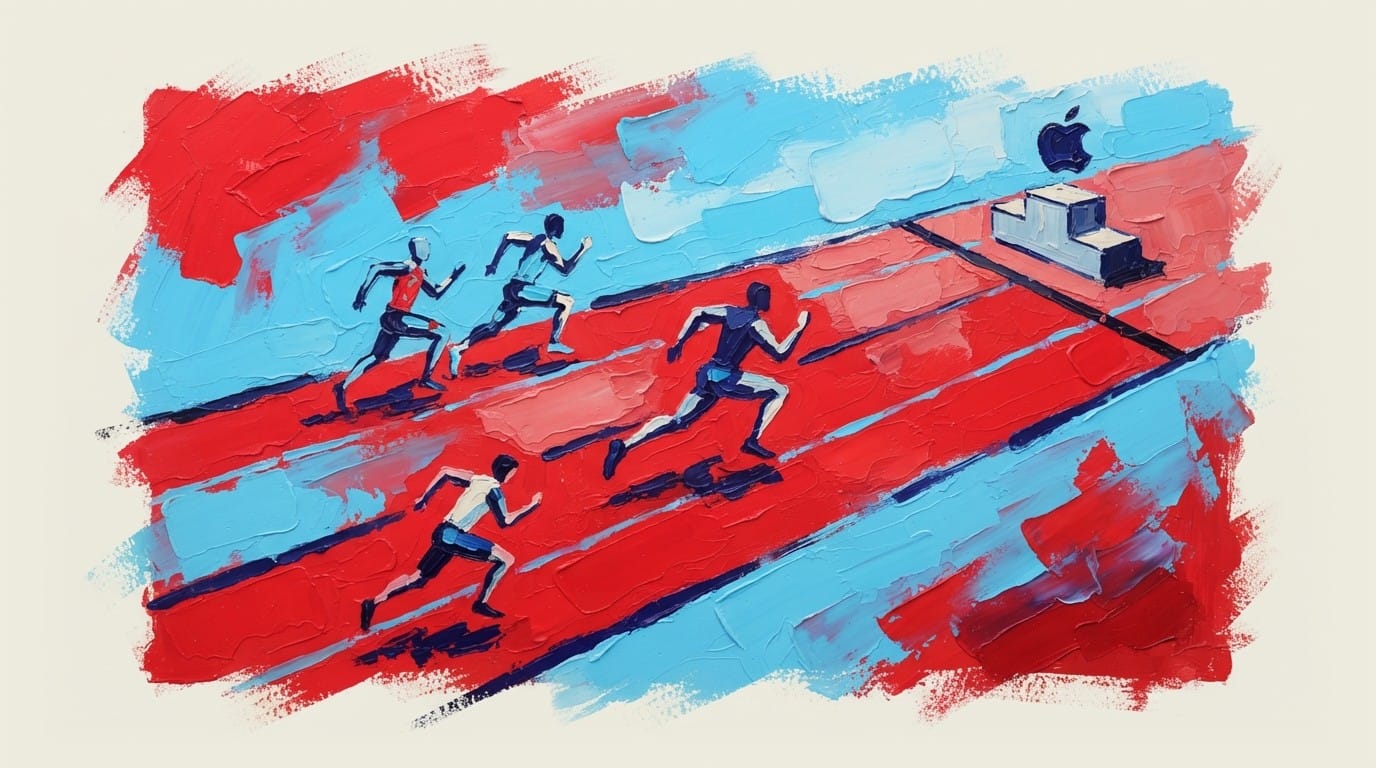
For most of the past three years, the AI competition looked like a two-horse race. OpenAI lit the fuse with ChatGPT, Anthropic followed with Claude and made a credible claim to being the more responsible lab, and everyone else was playing catch-up. That picture has shifted. xAI has closed ground faster than almost anyone predicted, OpenAI briefly fell behind Anthropic before staging a comeback, and the entire field is now being capitalised at a scale that makes the earlier skirmishes look like a warm-up. The race is genuinely crowded. And the most interesting competitor hasn't entered yet.
The search-era playbook doesn't apply here
The conventional wisdom about AI market structure borrowed heavily from the search era: one dominant model would capture the network effects, and the rest would be irrelevant. That logic turns out to be weaker in AI than it was in search. Models are improving fast enough that last quarter's frontier is this quarter's mid-tier. No single lab has sustained a commanding lead. OpenAI, the company that sparked the boom, fell far enough behind Anthropic at one point that it was publicly framed as a comeback story. That is a remarkable sentence to be able to write about the category's founder.
xAI's rise is the sharpest case study in how quickly the table can turn. Eighteen months ago it was not considered a serious AI company. Now, folded into SpaceX and backed by the infrastructure investment that comes with that, it has completed what sources describe as the world's largest IPO and is deploying compute at a scale that puts it in direct contention with the established labs. The pace matters as much as the position. If xAI could move that fast from standing start, the structural barriers to entry are lower than the incumbents would prefer.
If xAI could move that fast from standing start, the structural barriers to entry are lower than the incumbents would prefer.
The race is now decided by capital staying power, not model quality alone
The reason for that is compute and capital, not secret sauce. Nvidia's commitment of up to $100 billion in AI compute for OpenAI has been described as the new blueprint for the industry, but it is also a sign of how capital-intensive this race has become. When the cost of staying competitive is measured in tens of billions of dollars, the question of who can sustain that spending is as important as which lab currently has the best model. OpenAI and Anthropic are both moving toward public listings. xAI has its SpaceX runway. Google and Meta have their existing revenue bases. The labs that lack a credible capital story will find themselves squeezed out not by losing on capability, but by simply running out of road.
Apple's absence is the most important unanswered question in AI
Which is exactly why Apple's absence is strange. The company has over a billion active iPhone users, chip design capabilities that have already proven competitive with dedicated AI hardware, and a distribution channel for on-device AI that no cloud-first competitor can easily replicate. Its privacy-first positioning, which once looked like a constraint, could be a genuine product differentiator in a world growing uncomfortable with how much AI systems ingest and retain. Apple Intelligence launched with modest ambitions and has been conspicuously quiet since. That may be strategic patience, or it may be an organisation genuinely struggling to move fast in a domain that rewards speed.
The historical parallel that keeps surfacing in this debate is Xerox, which invented much of what became the personal computing era and then failed to capitalise on it. Google and Meta are unlikely to be Xeroxed out of existence. But the comparison is instructive as a warning about the difference between inventing something and owning it. OpenAI invented the modern AI moment. Whether it owns the next phase of it is an open question, and one that the current field is actively contesting.
A fragmented market means faster disruption, not less
For the Australian context, the competitive dynamics in this market matter more than they might appear. As governments scramble to set frameworks for AI governance and workers grapple with what automation means for their industries, the assumption that AI capability will concentrate in one or two dominant systems is increasingly hard to defend. A more fragmented, more competitive market is likely to produce faster capability gains and more unpredictable deployment timelines than a tidy duopoly would have.
The race is crowded, the lead is thin, and the competitor with perhaps the most interesting hand to play is still standing at the gate. That is not a stable picture. It is the part of the race where things get genuinely hard to predict.
Frequently Asked Questions
Why hasn't Apple released a serious AI product yet?
Apple Intelligence launched with modest ambitions and has been quiet since, which either reflects deliberate strategic patience or genuine difficulty moving fast in a domain that rewards speed. Apple's assets — a billion-plus iPhone users, competitive custom chips, and a privacy-first brand — are real, but assets and execution are different things.
Is there still a dominant AI company, or has the market fragmented?
The market has fragmented. No single lab has sustained a commanding lead: OpenAI fell behind Anthropic and had to stage a comeback, and xAI went from standing start to serious contender in roughly eighteen months. The search-era assumption that one model would capture all the network effects has not held.
How does AI competition affect Australian businesses and workers?
A more competitive AI market produces faster capability gains and less predictable deployment timelines than a tidy duopoly would. For Australian businesses already navigating rapid AI adoption, that means the next wave of disruption is likely to arrive sooner and be harder to forecast than a consolidated market would suggest.
Why does capital matter so much in the AI race?
Staying at the frontier now costs tens of billions of dollars in compute. Labs without a credible long-term capital story risk being squeezed out not by losing on model quality but by running out of money — which is why OpenAI and Anthropic are moving toward public listings and xAI's SpaceX backing matters strategically.
What is the Xerox warning for AI companies?
Xerox invented core personal computing technology but failed to commercialise it, letting others build the industry on its foundations. The parallel for AI is that inventing the modern moment — as OpenAI did — does not guarantee owning the next phase of it, especially when the competitive field is moving this fast.