Twenty years of Chinese state planning have upended the global car industry
China decided two decades ago it couldn't win the old car race — so it changed the game entirely. Now the West is scrambling to respond.

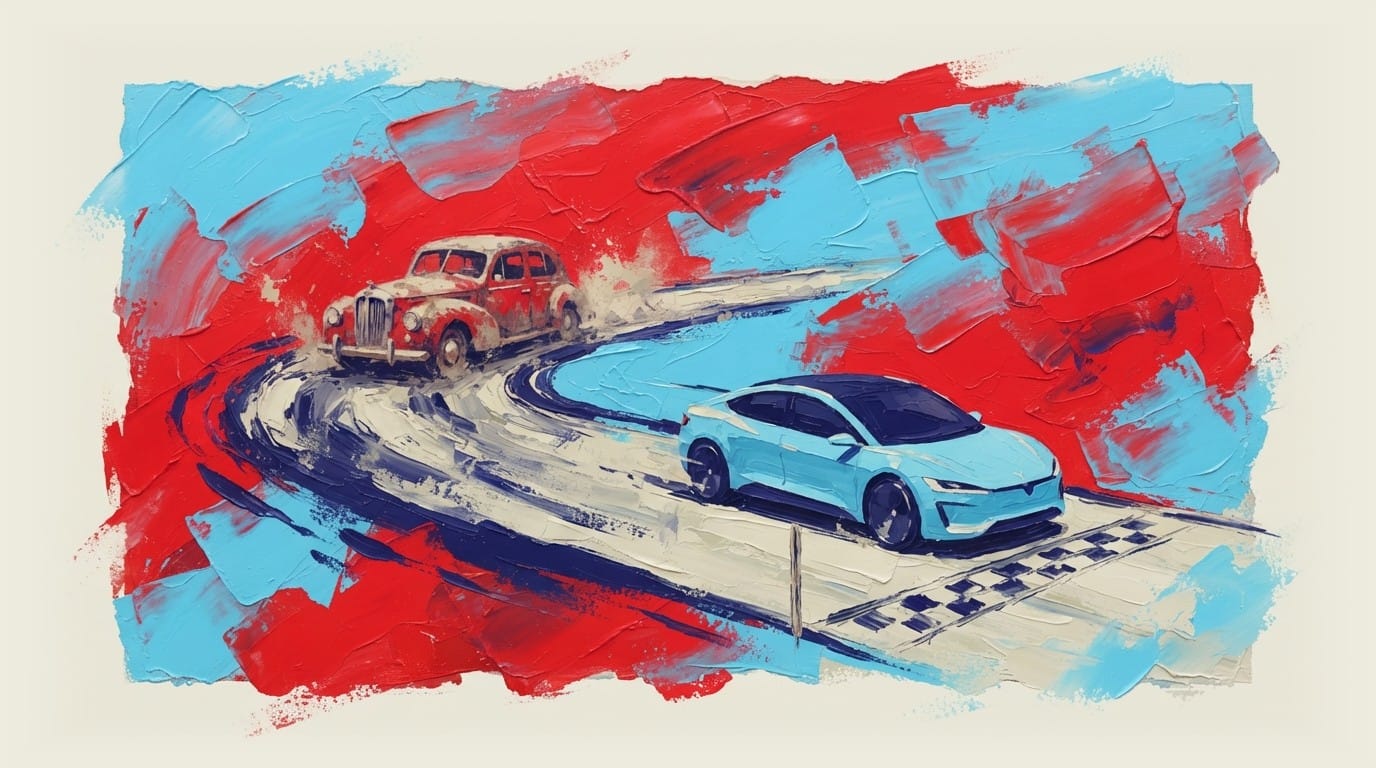
The world's biggest car exporter twenty years ago was Japan. Today it is China. That reversal did not happen because Chinese engineers stumbled onto a better idea or because Western carmakers grew complacent in the ordinary way of things. It happened because the Chinese government decided, in the early 2000s, that it would not compete on internal combustion engines, placed a twenty-year bet on electric vehicles, and then spent and planned its way to winning it.
China's opening move was to concede the old game entirely
The starting point matters. In the early 2000s, China's car industry was real but modest, its domestic market dominated by European and Japanese manufacturers who had struck joint-venture deals with local firms. Chinese policymakers looked at that map and drew a clear conclusion: they could not catch Toyota or Volkswagen on their own terms. The combustion engine was a mature technology, the Japanese had hybrids sewn up with the Prius, and the supply chains and engineering expertise needed to compete were already elsewhere.
Electric vehicles, by contrast, were essentially nowhere. Tesla had not yet released a car. The EV was a curiosity, a repeated failed experiment by General Motors and others who had shelved promising models under pressure from dealers, oil companies, and their own short-term profit calculations. GM's EV1, briefly available in the late 1990s, was discontinued in 2003 precisely as China's leaders were writing EVs into their Five-Year Plan.
The domestic market was brutal enough to produce genuine scale
From that point the divergence in approach is almost architectural. China built through patient accumulation: subsidies, tax breaks, infrastructure, and protected domestic competition fierce enough to drive genuine innovation. Between 2009 and 2022, Chinese authorities provided over A$41 billion in support to EV manufacturers, taxi fleets, and bus networks. CATL, now the world's dominant battery manufacturer, grew from a consumer electronics battery supplier. BYD, now the world's largest EV manufacturer, followed a similar path. The domestic market was brutal, as the source material notes, with price wars and constant competitive pressure, but that pressure produced scale and efficiency rather than killing the industry outright.
The CEOs of Japanese automakers have been particularly candid about this. Toyota's chairman last month admitted EVs were his "biggest fear" while simultaneously saying he loved engines.
Western carmakers faced a different structure entirely. Changing political cycles meant government support was never guaranteed for long enough to justify the capital required to retool. Their shareholder base demanded returns on a quarterly rhythm. Their dealer networks, supplier chains, and unions were all built around combustion engines, and EVs require roughly thirty per cent less labour to manufacture, which made every stakeholder with a stake in existing jobs resistant to the transition. The CEOs of Japanese automakers have been particularly candid about this. Toyota's chairman last month admitted EVs were his "biggest fear" while simultaneously saying he loved engines. That kind of institutional ambivalence, expressed from the top of the world's second-largest carmaker, tells you something about how deeply the resistance runs.
State planning built an industry; venture capital built one company
Tesla is the only exception, and the contrast is instructive. The biggest Western EV manufacturer is not a legacy carmaker at all. It is a startup that never had a combustion engine business to protect, no dealer network to placate, no union workforce invested in the old technology. Tesla succeeded for exactly the reasons Western legacy carmakers struggled: it had no existing structure pulling it backward. The Chinese model produced BYD through state planning. The Western world produced Tesla through venture capital and individual conviction. Both paths generated real innovation, but only one of them scaled an entire national industry.
The results are now visible in the sales figures. China's car exports passed Japan's in 2023, reaching almost five million vehicles across more than 180 countries. BYD launched in Australia in 2022 and is now the country's second-biggest car brand. Volkswagen, once China's dominant foreign brand, has announced plans to cut 100,000 jobs worldwide. Honda's CEO toured a Shanghai EV factory and said, plainly, "we have no chance against this." Ford's CEO called it "a fight for our lives."
Liberal democracies are structurally disadvantaged at twenty-year bets
The policy question this raises is not really about admiring China's industrial planning in the abstract. It is about understanding what the structure actually produced and why Western equivalents were not built. The honest answer is that liberal democracies with short electoral cycles and private capital markets are structurally disadvantaged at this kind of twenty-year commitment. That is not a flaw unique to any one government — it is an institutional feature that applies regardless of which party holds office. Australia's own EV charging infrastructure remains fragmented and underfunded, a local illustration of exactly the same coordination problem at smaller scale.
The tariff walls now going up around EV imports in the United States and Europe are a tacit acknowledgement that the industrial competition has already been decided. Tariffs can slow the displacement of legacy carmakers. They cannot close a twenty-year gap in battery technology, supply chain integration, and manufacturing scale. China ran its race. The others are still looking for the starting line.
Sources
Frequently Asked Questions
Why did China become the world's biggest car exporter so quickly?
China made a deliberate decision in the early 2000s to skip competing on combustion engines and instead invest heavily in electric vehicles through subsidies, Five-Year Plans, and protected domestic competition. That two-decade industrial strategy produced companies like BYD and CATL that now dominate global EV manufacturing and exports.
How much did China spend subsidising electric vehicles?
Between 2009 and 2022, Chinese authorities provided over A$41 billion in support to EV manufacturers, taxi fleets, and bus networks. That sustained public investment helped Chinese firms achieve the scale and supply chain integration that Western carmakers have not been able to match.
Why didn't Western carmakers just copy China's EV strategy?
Western carmakers faced structural obstacles China did not: short political cycles that made long-term government support unreliable, shareholder pressure for quarterly returns, and existing workforces and supply chains built around combustion engines. EVs require roughly thirty per cent less labour to manufacture, making every stakeholder with a stake in existing jobs resistant to the transition.
Will tariffs on Chinese EVs protect Western car manufacturers?
Tariffs can slow the displacement of legacy carmakers, but they cannot close a twenty-year gap in battery technology, supply chain integration, and manufacturing scale. The US and Europe are raising tariff walls as a holding measure, not a competitive response.
What does China's EV dominance mean for Australian car buyers?
BYD launched in Australia in 2022 and is already the country's second-biggest car brand, meaning Chinese EVs are arriving in volume without the tariff barriers that the US and Europe have imposed. Australia's EV charging infrastructure remains fragmented and underfunded, creating a gap between the cars now available and the public infrastructure needed to support them.