Minister claims 'world-leading' AI stance to protect us
Australia's government calls its AI framework 'world-leading' — but leading toward what outcome, measured against what benchmark?

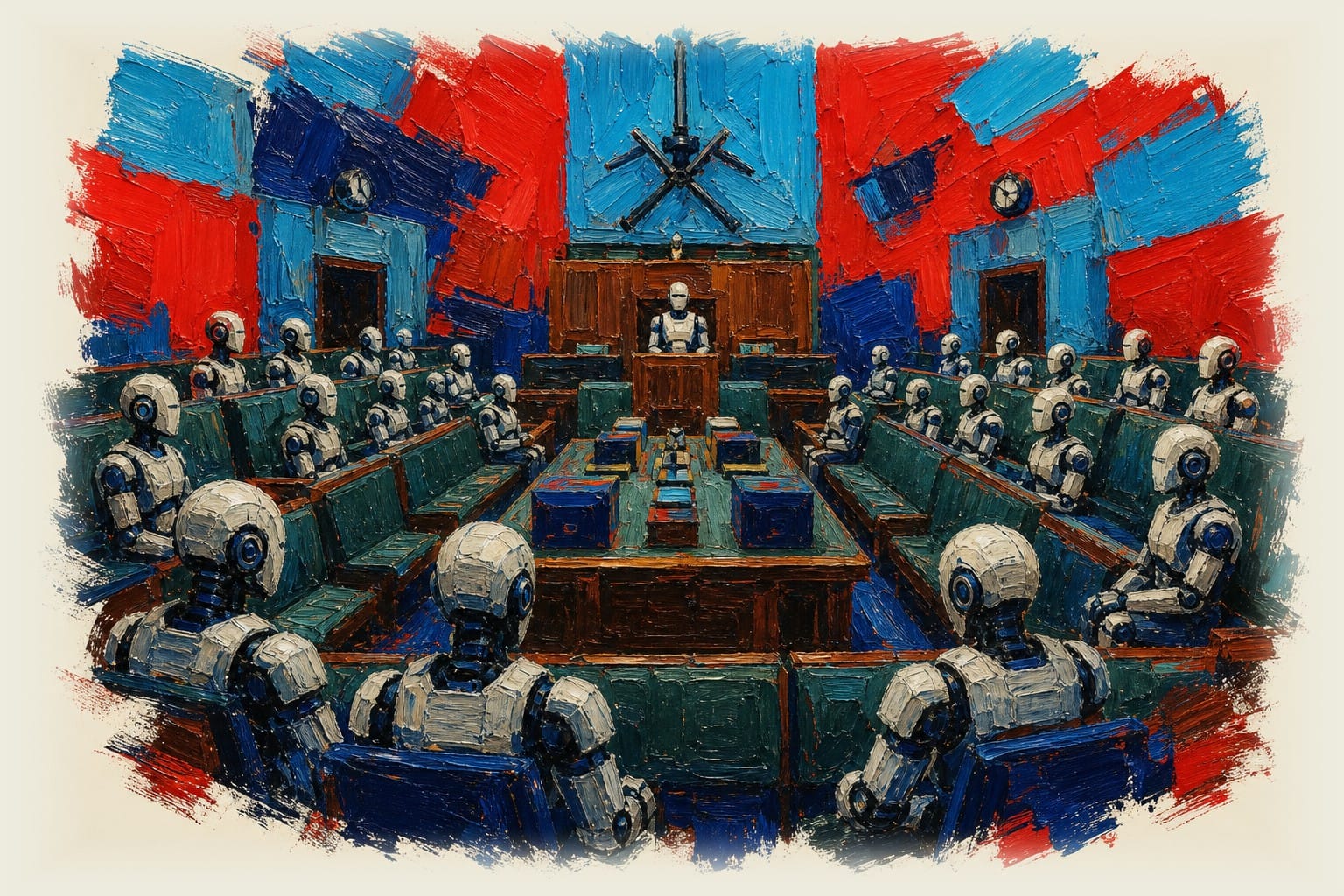
When Australia's Industry and Innovation Minister Tim Ayres sat down with News 24 this week, the language he reached for was revealing. AI is an "industrial scale threat." Australia must not become "a cork bobbing on the ocean." The government's response is, naturally, "world-leading." It is the vocabulary of a country bracing for something, not one rushing to embrace it.
The contrast with Washington is not accidental — it is a deliberate governing choice
The contrast with Washington is not incidental. The Trump administration has made AI a centrepiece of American economic ambition, framing it primarily as a competitive advantage to be seized and a regulatory burden to be stripped away. Ayres is doing something different. He is describing the same technology as something that needs to be governed before it is exploited, and he is building institutions, a joint select committee, an AI Safety Institute, mandatory standards, around that premise.
That is a legitimate position. It is not self-evidently correct, but it is defensible. The question is whether "world-leading" is doing accurate work here, or whether it is a ministerial superlative filling the space where specifics should be.
The actual content of the government's AI framework, as Ayres described it, has three parts: mandatory AI standards for large data centres, an AI Safety Institute coordinating with eight international counterparts, and a push for appropriate investment in the national interest. The first is a regulatory lever. The second is an information-gathering and standard-setting body. The third is an ambition rather than a mechanism. Together they constitute a frame more than a finished building.
Australia's seat at the frontier model table is real — but limited by what it can do with the information
The AI Safety Institute coordination claim is worth taking seriously. Australia being inside the room where frontier model evaluation is happening — alongside equivalents in the UK, the US, Japan, and elsewhere — is genuinely valuable. If the institute has real access to how large models behave under the hood, that is not nothing. The Anthropic reference the interviewer raised, about AI moving faster than even its own developers expected, points to exactly the kind of risk that safety institute work is designed to catch. But as we've noted before, the Australian government's record on AI policy design has not always matched the ambition of its announcements.
Protection and opportunity are not mutually exclusive, but they do create different incentive structures for the private sector and different expectations for the public.
The mandatory standards for data centres are a more concrete commitment, and the logic is sound in outline. If Australia is going to host the infrastructure underpinning AI development, having requirements around power sourcing, water use, and grid contribution is reasonable planning. The failure mode is specificity: standards that are too vague to enforce, or that are calibrated to the preferences of large operators rather than to genuine public interest.
The scam question Ayres didn't answer is the one that matters most to ordinary Australians
The scam question the interviewer raised is the one that bites most directly for ordinary Australians. Ayres did not really answer it, because the question was folded into a faster conversation about energy policy. But it matters. AI-enabled fraud is already operating at a scale that individual Australians cannot defend against on their own, and a June 2026 audit found that Treasury lacks the basic risk management and coordination infrastructure to oversee even the existing scams framework. An AI Safety Institute that evaluates frontier models at the technical level does not automatically fix the enforcement gap at the consumer level.
The energy section of the interview, which took up the back half, was a different kind of conversation entirely. Ayres defended coal exports while talking about emissions reduction, which is a genuinely contested position rather than a hypocritical one — Australia's trading partners burning coal is not the same as Australia burning it domestically, and the jobs and revenue arguments are real. But it illustrated how quickly the AI policy conversation can be crowded out by the government's own portfolio tensions.
"World-leading" forecloses the harder question: leading toward what?
The risk of "world-leading" framing is not that it is false. It may be partially true. The risk is that it forecloses the harder conversation: leading in what direction, toward what outcome, measured against what benchmark? Protection and opportunity are not mutually exclusive, but they do create different incentive structures for the private sector and different expectations for the public. A government that frames AI as a threat to be managed will build different institutions than one that frames it as a wave to ride — and the institutions you build shape the outcomes you get.
Australia is building cautiously. That may prove wise. The evidence, so far, is still coming in.
Sources
Minister for Industry and Innovation — Interview on News 24 First Edition
The Bearing — Government's AI copyright pledges show a lack of AI understanding
The Bearing — News Flash: The Government Can't Protect You From Being Scammed
Frequently Asked Questions
What is Australia's AI Safety Institute and what does it actually do?
Australia's AI Safety Institute coordinates with eight international counterparts to evaluate frontier AI models — assessing how large models behave at a technical level before they are widely deployed. It is an information-gathering and standard-setting body, not an enforcement agency, which means it can identify risks without necessarily having the power to compel action on them.
How does Australia's approach to AI regulation differ from the United States?
The Trump administration frames AI primarily as a competitive economic opportunity and has moved to strip back regulatory requirements. The Australian government, by contrast, treats AI as a risk to be governed before it is exploited, building institutions around safety and mandatory standards rather than market-led adoption. These are genuinely different postures, and they tend to produce different kinds of institutions and incentive structures for the private sector.
Why can't Australians rely on the government to protect them from AI-enabled scams?
A 2026 audit found that Treasury lacks the basic risk management and coordination infrastructure to oversee even the existing scams framework — before AI-enabled fraud is factored in. The AI Safety Institute evaluates models at a technical frontier level, which is a separate function from the consumer-facing enforcement gap that allows scams to reach ordinary Australians at scale.
What are Australia's mandatory AI standards for data centres?
The government has committed to legislated requirements for large data centres covering areas like power sourcing, water use, and grid contribution — the physical infrastructure underpinning AI development. The stated logic is sound, but the critical risk is that standards are written too vaguely to enforce, or are calibrated to the preferences of large operators rather than genuine public interest.
Is a cautious approach to AI regulation better or worse for economic outcomes?
There is no settled answer. A protection-first framing creates different incentive structures for private sector investment than an opportunity-first one, and the institutions a government builds around its framing tend to shape the outcomes it gets. Australia's cautious stance may prove wise if AI risks materialise as feared — or it may slow adoption and investment if they do not.