Victoria to pull it’s own statues down
Victoria's new Premier has abolished a 25-year-old statue policy and called it fiscal responsibility — the numbers tell a different story.

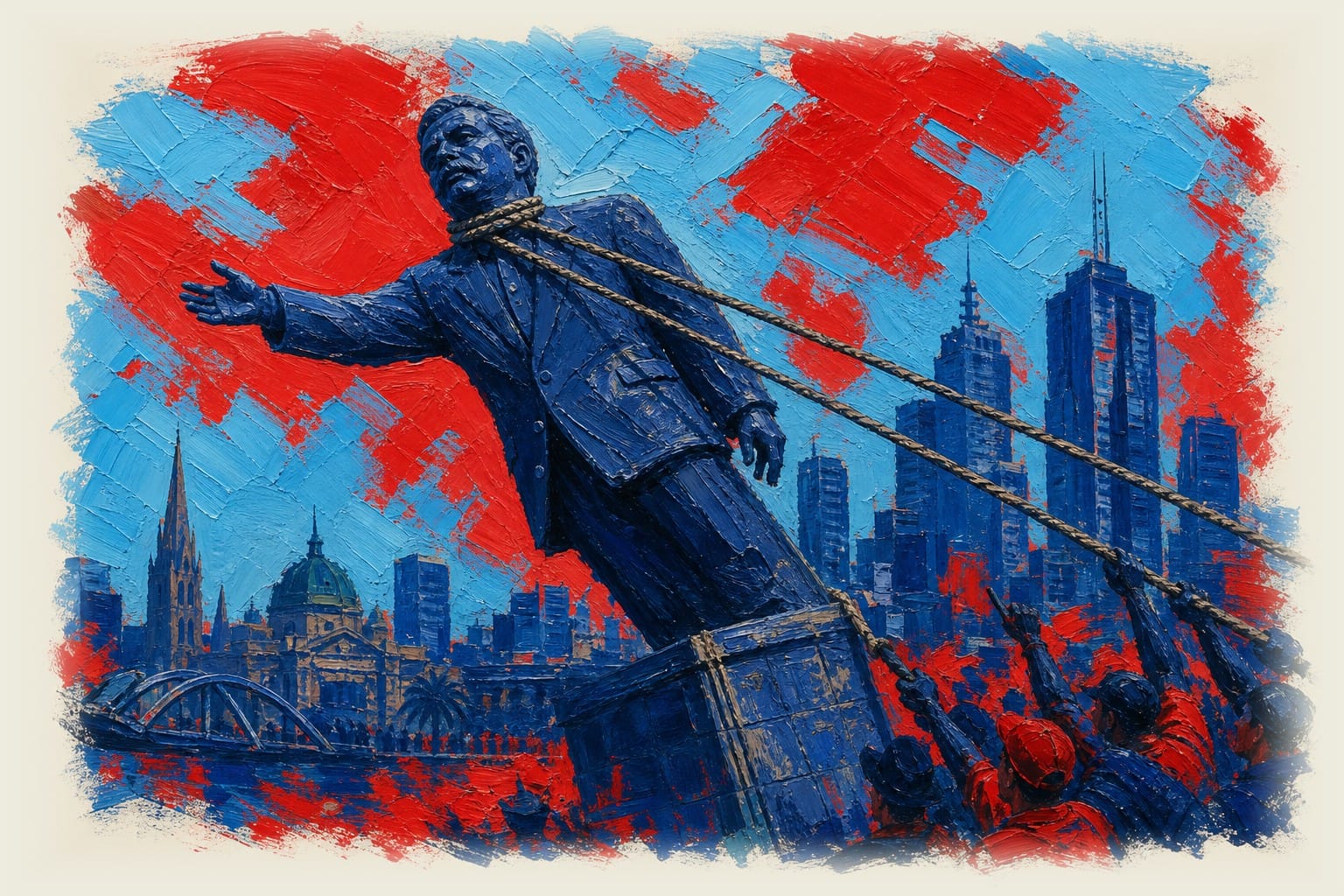
A government under fiscal pressure, facing a state whose voters are exhausted and sceptical of their political class, has found a novel solution: attack the political class symbolically, at minimal cost, and hope that counts for something. Premier Ben Carroll announced this week that Victoria will end the automatic policy of commissioning statues of long-serving Premiers, a convention introduced by Jeff Kennett in 1999. Work on a statue of the state's 48th Premier will stop mid-commission. An independent panel will be appointed to review how Victoria commemorates former officials. The whole thing costs nothing, changes nothing material, and is designed to be seen, not felt.
The fiscal framing is a category error — but a politically useful one
The policy Carroll is abolishing was never going to break the state. A bronze statue costs the order of hundreds of thousands of dollars, not millions, in a state budget measured in the hundreds of billions over any forward estimate period. Framing this as respect for taxpayers' money is a category error, though a politically useful one. The money is not the point. The message is.
That message is legible enough. Victoria is a state that has watched its debt load grow substantially, its public services strain, and its politics feel increasingly remote. The Carroll government, still finding its footing after Jacinta Allan's departure, needs to establish that it is different from what came before. It cannot do that with budget outcomes yet. So it does it with statues.
This is a government making a symbolic gesture against symbols — deploying the exact mechanism it is criticising: the use of public acts to signal values, rather than to achieve outcomes.
Ending the statue policy is itself a statue policy
There is a real irony at work here that deserves to be named plainly. This is a government making a symbolic gesture against symbols. It is deploying the exact mechanism it is criticising: the use of public acts to signal values, rather than to achieve outcomes. The statue policy existed to tell a story about how Victoria honours service. Ending the statue policy exists to tell a different story about how Victoria values money. Neither one repairs a hospital, trains a teacher, or keeps a police station staffed by an officer who actually has powers.
Carroll's stated framing, that automatic statues are "no longer consistent with community expectations about how governments should spend money," is worth examining. It implies there was once a community expectation that they were. There almost certainly was not. The 1999 Kennett policy was a piece of institutional self-congratulation that sailed through unremarked because nobody much cared. Nobody much cares now either, except that Carroll is making them care by ending it. The gesture creates the impression of responsiveness to public sentiment that was never actually expressed.
The panel review is a genuinely sensible reform — just not the one that matters
The automatic statue policy was a reasonable candidate for abolition, and convening a broader panel to review how Victoria commemorates former officials is not a bad idea. State funerals do cost real money, and protocols that are explicit and consistent are better than ones that are not. These are genuinely sensible reforms. They are just not the reforms that are going to shift anything for the people voting in the next election.
Symbolic solidarity has a short half-life
The Carroll government is making a calculated bet that being seen to understand the mood is politically close enough to actually changing it. That bet is not irrational. Voters who feel that the political class is insulated and self-serving respond to signals that someone in that class has noticed. The problem, visible in Victoria's recent political history and in the broader pattern of Labor's shallow majority nationally, is that symbolic solidarity with public frustration has a short half-life. It works as an opener. It does not work as a strategy.
Carroll has shown he can read a room. The harder question, and the one this week's announcement does nothing to answer, is whether he can change what the room looks like.
Sources
Victorian Government Media Releases — Recognising Former Public Officials Respectfully
Frequently Asked Questions
Why is Victoria scrapping statues of former Premiers?
Premier Ben Carroll announced that the automatic policy of commissioning statues of long-serving Premiers — introduced by Jeff Kennett in 1999 — is being abolished. The stated reason is that it no longer reflects community expectations about government spending, though the actual cost of a statue is hundreds of thousands of dollars against a state budget in the hundreds of billions.
How much does a Premier's statue actually cost Victorian taxpayers?
A bronze statue costs in the order of hundreds of thousands of dollars. That is not a trivial sum individually, but it is fiscally immaterial against a state budget measured in the hundreds of billions over any forward estimate period. The savings from this policy change will not register in Victoria's fiscal position.
What will the independent panel on commemorating former officials actually do?
The panel will review how Victoria recognises former public officials, covering conventions such as state funerals and other forms of commemoration. The article notes that explicit, consistent protocols are better than ad hoc ones — but the panel's terms of reference, composition, and reporting timeline have not been detailed publicly.
Is this a real reform or just political theatre?
Both things are true simultaneously. Abolishing an automatic statue policy is a reasonable decision, and a review of commemoration protocols is sensible administration. But the political purpose of the announcement is to signal fiscal responsibility and distance from the political class — not to change anything material for Victorian households.
How long does symbolic politics work before voters stop responding?
The article argues that symbolic gestures against the political class work as an opener but not as a strategy — they have a short half-life. Voters who feel the political class is self-serving respond initially to signals of awareness, but the effect fades if it is not followed by tangible policy change.